

Course Duration
4 Hours
4 Hours
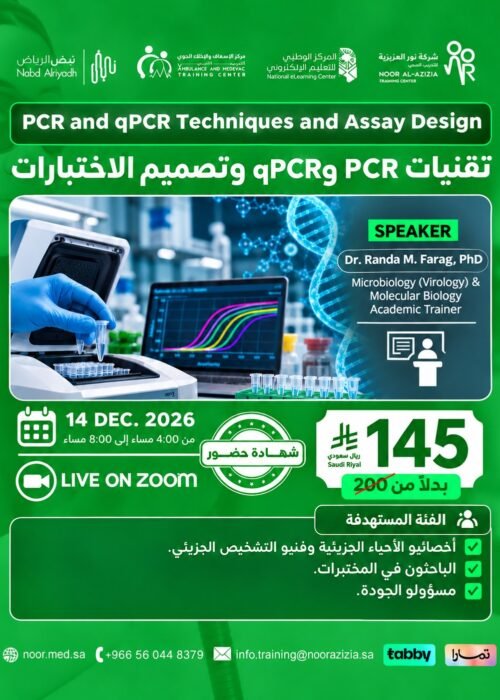
Course Date
December 14, 2026
December 14, 2026
Time
4:00 PM – 8:00 PM
4:00 PM – 8:00 PM
Delivery Method
Online via Zoom
Online via Zoom
Speaker:
Dr. Randa M. Farag, PhD – Microbiology (Virology) & Molecular Biology, Academic Trainer.
Dr. Randa M. Farag, PhD – Microbiology (Virology) & Molecular Biology, Academic Trainer.
Course Fee:
SAR 145 instead of SAR 200.
SAR 145 instead of SAR 200.
Certificate:
Certificate of Attendance.
Certificate of Attendance.
Payment Methods:
Installment payments available through Tabby and Tamara.
Installment payments available through Tabby and Tamara.
General Objective
To enable participants to understand the principles of PCR and qPCR techniques and the design of reliable amplification assays, as well as how to read and interpret results and avoid false results.
Application in Laboratory Diagnostics:
Developing reliable amplification assays, reading and interpreting results, and avoiding false-negative and false-positive results.
Training Objectives & Course Topics
Principles of PCR, qPCR, and RT-qPCR
40 Minutes
40 Minutes
Primer and Probe Design
50 Minutes
50 Minutes
Amplification Curves and Interpretation Criteria
50 Minutes
50 Minutes
Positive, Negative, and Internal Controls
50 Minutes
50 Minutes
Workshop: Reading Amplification Curves and Interpreting Cases
50 Minutes
50 Minutes
Total Course Duration
4 Training Hours (240 Minutes).
4 Training Hours (240 Minutes).
Learning Outcomes
By the end of this course, participants will be able to:
Differentiate between PCR, qPCR, and RT-qPCR and explain the stages of each technique.
Apply the principles and rules of primer and probe design.
Read amplification curves and interpret Ct values.
Select appropriate controls and interpret their results.
Identify the causes of false results and develop appropriate solutions to prevent them.
What You Will Learn
How amplification techniques work and how amplification is measured in real time.
How to design suitable primers and probes for diagnostic assays.
How to read amplification curves and interpret Ct values.
The role of controls in ensuring reliable test results.
How to detect and prevent false-positive and false-negative results.
Target Audience
Molecular biology specialists and molecular diagnostics technicians.
Laboratory researchers.
Quality officers.

ر.س 145.00
Share This Course