
Course Duration
4 Hours
4 Hours
Course Date
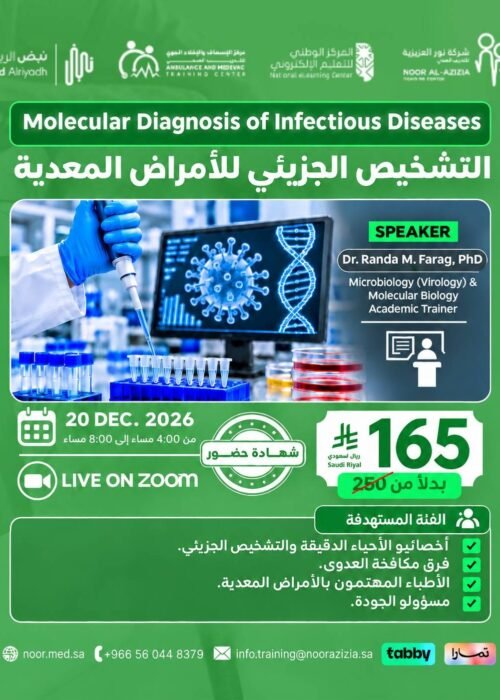
December 20, 2026
December 20, 2026
Time
4:00 PM – 8:00 PM
4:00 PM – 8:00 PM
Delivery Method
Online via Zoom
Online via Zoom
Speaker:
Dr. Randa M. Farag, PhD – Microbiology (Virology) & Molecular Biology, Academic Trainer.
Dr. Randa M. Farag, PhD – Microbiology (Virology) & Molecular Biology, Academic Trainer.
Course Fee:
SAR 165 instead of SAR 250.
SAR 165 instead of SAR 250.
Certificate:
Certificate of Attendance.
Certificate of Attendance.
Payment Methods:
Installment payments available through Tabby and Tamara.
Installment payments available through Tabby and Tamara.
General Objective
To enable participants to apply molecular diagnostic tests for detecting infectious disease pathogens, interpret results in the context of the specimen and clinical condition, and implement practices that help minimize cross-contamination.
Application in Laboratory Diagnostics:
Selecting the appropriate molecular test, interpreting results in relation to the specimen type and clinical condition, and applying measures to minimize cross-contamination.
Training Objectives & Course Topics
Molecular Detection of Infectious Disease Pathogens
40 Minutes
40 Minutes
Single-Target and Multiplex Assays
50 Minutes
50 Minutes
Distinguishing the Presence of Genetic Material from Clinical Significance
50 Minutes
50 Minutes
Cross-Contamination Control and Workflow Organization
50 Minutes
50 Minutes
Workshop: Interpreting Diagnostic Case Results
50 Minutes
50 Minutes
Total Course Duration
4 Training Hours (240 Minutes).
4 Training Hours (240 Minutes).
Learning Outcomes
By the end of this course, participants will be able to:
Select the appropriate molecular test based on the suspected pathogen and specimen type.
Differentiate between single-target and multiplex assays and understand the advantages of each.
Interpret test results in the context of the specimen type and clinical condition.
Distinguish between the presence of genetic material and an active infection.
Apply procedures to minimize cross-contamination in the laboratory.
What You Will Learn
When molecular testing is the most appropriate diagnostic approach.
How to carefully read and interpret positive and negative results.
Why genetic material may be detected even when there is no active infection.
How to organize the laboratory workflow to prevent cross-contamination.
How to communicate unexpected results effectively with physicians.
Target Audience
Microbiology and molecular diagnostics specialists.
Infection prevention and control teams.
Physicians interested in infectious diseases.
Quality officers.

ر.س 250.00ر.س 165.00
Share This Course