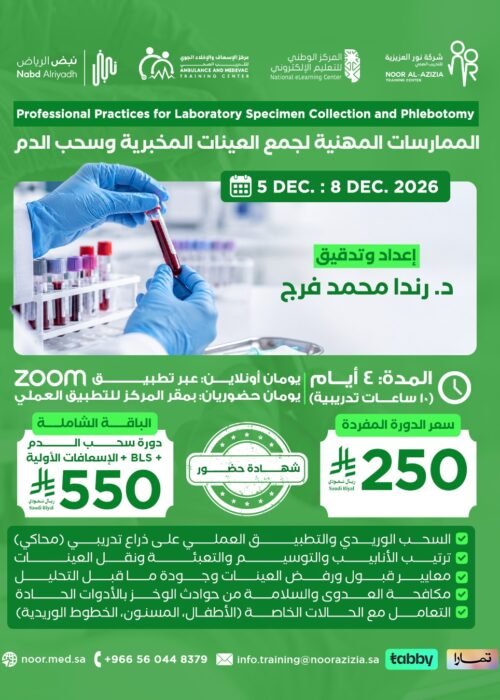

4 Training Days (10 Training Hours)
05/12/2026
08/12/2026
Certificate of Attendance
2 Online Days via ZOOM and 2 On-site Training Days at the Center
Professional Practices for Laboratory Specimen Collection and Phlebotomy
Total Training Hours: 10 Hours
Date: December 5–8, 2026
Trainer: Dr. Randa Mohamed Farag
Language: Arabic
Online Learning and On-site Practical Training Using a Phlebotomy Training Arm Simulator
Course Fee: SAR 250
Installment Payments Available via Tabby and Tamara
Training Topics
1. The Pre-Analytical Specimen Journey and Risk Points.
2. Anatomy Fundamentals: Veins, Site Selection, and Appropriate Equipment.
3. Safety, Infection Prevention and Control, and Needlestick Injury Management.
4. Standard Venous Blood Collection Procedures, Order of Draw, and Specimen Labeling.
5. Special Specimens, Acceptance and Rejection Criteria, and Pre-Analytical Quality.
6. Simulation, Practical Skills Assessment, and Examinations.
7. Operational Forms, Performance Indicators, and Quality Improvement.
Program Overview
The training program “Professional Practices for Laboratory Specimen Collection and Phlebotomy” aims to equip healthcare practitioners with the knowledge and practical skills required to apply safe professional practices in laboratory specimen collection and venous blood sampling, in subject-matter alignment with ISO 20658:2023 and relevant quality and safety principles.
The program covers all stages of specimen collection, starting with patient identification and laboratory request verification, followed by appropriate vein and site selection, equipment preparation, and performing standardized blood collection procedures. It also addresses specimen labeling, packaging, transportation, and documentation according to established requirements.
The program further focuses on infection prevention and control, safe handling of sharps, needlestick injury prevention, and managing special patient populations, including children, elderly patients, patients receiving anticoagulants, and patients with intravenous lines.
Participants will also learn specimen acceptance and rejection criteria, risk management, and methods for improving pre-analytical quality.
Program Benefits:
• Understand professional practices for laboratory specimen collection and venous blood sampling.
• Understand the specimen journey and identify potential risks during the pre-analytical phase.
• Practice vein identification and appropriate blood collection site selection.
• Apply standardized blood collection procedures, tube order of draw, and specimen labeling.
• Understand laboratory specimen acceptance and rejection criteria.
• Apply infection prevention, occupational safety, and safe sharps handling practices.
• Learn how to manage special cases, including children, elderly patients, and patients receiving anticoagulants.
• Develop skills in specimen documentation, packaging, and safe transportation.
• Participate in practical training using a phlebotomy training arm simulator.
• Learn operational forms and performance indicators for quality improvement.
Program Date:
December 5–8, 2026.
Program Duration:
4 Training Days (10 Training Hours).
2 Online Days via ZOOM and 2 On-site Training Days at the Center.
Course Fee:
SAR 250.
Payment Methods:
Installment payments available via Tabby and Tamara.
Certificate:
Certificate of Attendance.
Professional Standards and References
The training content is developed in subject-matter alignment with the relevant principles and requirements of:
• ISO 20658:2023 – Requirements for the Collection and Transport of Samples for Medical Laboratory Examinations.
• Patient Safety Principles and Correct Patient Identification.
• Infection Prevention and Control Standards.
• Pre-Analytical Quality Management Principles.
• Professional Practices for Specimen Documentation, Packaging, and Transportation.
Practical Training Activities
The Pre-Analytical Specimen Journey and Identification of Risk Points.
Vein Anatomy, Blood Collection Site Selection, and Appropriate Equipment.
Infection Prevention, Safety Precautions, and Needlestick Injury Management.
Practical Venous Blood Collection Using a Training Arm Simulator.
Blood Collection Tube Order of Draw, Labeling, Packaging, and Transportation.
Special Specimens and Specimen Acceptance and Rejection Criteria.
Managing Special Cases: Children, Elderly Patients, Patients Receiving Anticoagulants, and Patients with Intravenous Lines.
Simulation and Practical Skills Assessment.
Operational Forms, Performance Indicators, and Quality Improvement.
General Objective
To qualify trainees to apply safe professional practices, in subject-matter alignment with ISO 20658:2023, in laboratory specimen collection and venous blood sampling, starting from patient identification through specimen documentation and transportation, ensuring patient and healthcare worker safety and the quality of laboratory results.
Learning Outcomes: What Will You Learn?
By the end of the program, participants will be able to:
• Explain the specimen journey from laboratory test request to laboratory receipt and identify pre-analytical risk points.
• Verify patient identity using two independent identifiers and match patient details with the laboratory request and specimen.
• Select appropriate blood collection equipment and sites according to the patient’s condition and healthcare facility policies.
• Identify situations that require stopping the procedure and seeking assistance.
• Perform the safe sequence of venous blood collection using a training simulator.
• Select appropriate blood collection tubes and apply the correct order of draw and mixing procedures according to manufacturer and laboratory instructions.
• Label, document, package, and transport specimens safely.
• Apply specimen acceptance and rejection criteria and follow escalation procedures.
• Recognize potential complications and exposure incidents and implement appropriate response and reporting procedures.
• Apply infection prevention and occupational safety principles during specimen collection and phlebotomy.
• Use operational forms and performance indicators to contribute to pre-analytical quality improvement.
What Will You Learn in This Program?
• Understand the specimen journey from the laboratory request to laboratory receipt and identify potential pre-analytical risks.
• Verify patient identity using two independent identifiers and match them with the request and specimen.
• Select appropriate veins, collection sites, and equipment, and recognize when to stop the procedure and seek assistance.
• Perform venous blood collection safely using a training arm simulator.
• Apply the correct order of draw and blood collection tube mixing procedures.
• Apply infection prevention precautions and safe sharps handling practices, including appropriate responses to needlestick injuries.
• Manage special cases, including children, elderly patients, patients receiving anticoagulants, and patients with intravenous lines.
• Label, package, transport, and document specimens correctly.
• Apply specimen acceptance and rejection criteria and escalation procedures.
• Measure quality performance using operational forms and performance indicators.
Practical Training Equipment
| Equipment | Practical Application |
|---|---|
| Training Arm Simulator | Practice vein identification and venipuncture without exposing patients to risk. |
| Needle, Holder, and Vacuum Tube System | Practice multi-tube blood collection using a safety device. |
| Butterfly Needle and Syringe | Learn alternative collection methods for small or fragile veins. |
| Blood Collection Tubes | Practice appropriate tube selection, order of draw, and mixing. |
| Tourniquet, Antiseptic, Gauze, and Dressing | Prepare the collection site and control bleeding after venipuncture. |
| Gloves, Personal Protective Equipment, and Sharps Container | Apply infection prevention measures and safe sharps disposal. |
| Specimen Labels and Leak-Proof Transport Containers | Practice specimen labeling, packaging, transportation, and handover. |
| Skills Observation Checklist and Documentation Forms | Practical assessment, documentation, and performance monitoring. |
| ZOOM Platform | Online learning activities, presentations, case studies, and assessments. |
Target Audience
• Medical Laboratory Specialists and Technicians.
• Phlebotomists.
• Nursing Professionals Authorized to Perform Blood Collection.
• Healthcare Students Under Appropriate Supervision.
• Quality and Patient Safety Officers.
• Healthcare Practitioners Interested in Developing Laboratory Specimen Collection Skills.
Trainer
Dr. Randa Mohamed Farag
Training Material Prepared and Reviewed by Dr. Randa Mohamed Farag.